In a Forbes article published in May 2020, Virtual Leadership– or leading teams that work from different locations- was dubbed as the ‘next big thing’. In the US, a study by Global Workplace Analytics published in June 2020 projects that the number of employees who will be working full time from home will grow by 733 percent.
The same pattern is projected for the Philippines. In a study conducted by Lenovo Philippines, 87% of employees are ready to shift to work from home permanently when required by their employers. While of course, our technical infrastructure may hinder what Forbes called work from home revolution, these numbers are significant because once upon a time, WFH isn’t a thing. It took 15 years – from 2005 to 2020 – for the number of full-time work-from-home employees to expand from three and a half million to five million people. During these period, the number of full time WFH employees just grow at a rate of 2.86% each year.
While there are many factors that would affect how this projections would translate especially in the Philippines where limited technological infrastructures primarily hinders companies into fully embracing remote work arrangements, strict quarantine policies have pushed companies and managers to adapt. In a future where work will be done in different locations and where interactions will be primarily behind virtual tools such as Google Meet, Zoom, Slack, Microsoft Teams, and others- how can young leaders stay authentic in the way we lead our remote teams?
- Make the choice to be a leader. At present where remote work arrangements are primarily done as an emergency response due to an ongoing pandemic, employees are navigating not just through the unfamiliarity of this work arrangement but also with the uncertainty and circumstances surrounding the crisis. Leaders have to make the deliberate choice to lead and not only manage their teams. Simon Sinek, author of Leaders Eat Last, describes leadership as a choice to look out for the person on your left and to look out for the person on your right. He further elaborates that leaders must take care of the people in their charge and not take charge of the job. This means that the leader’s job is to put the interest of their employees first and not even the customers. When we take care of our employees, they will take care of our customers. Leaders make tons of decisions on a daily basis and each decision will have an impact on the organization’s stakeholders and even to his own self. But to subscribe to Sinek’s leadership philosophy means to prioritize our people and set their best interests at the core of our decision-making processes.
- Maximize virtual tools that serve your team’s purpose. Because you are in different locations, it requires a different set of tools too. While there are hundreds of virtual tools to support remote work, the fundamental question leaders must ask is how do we transform the work we do on-site to a virtual space? Tools are only great and effective if they meet your team’s needs and resources. In our team, there were three categories of virtual tools we had to use in order to transform the work we physically do in school to our virtual space: operations, communication, and school-specific tools. More on this topic in my next blog.
- Regularly communicate with your team and do it authentically. One of the challenges of doing remote work for any employee is the feeling of isolation and loneliness. Even before the pandemic, remote workers have already reported loneliness as their biggest struggle in doing remote work.
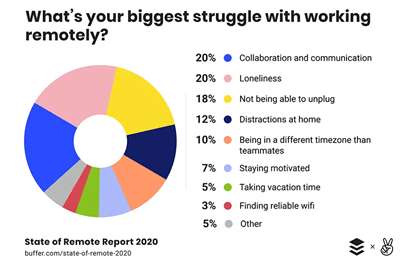
As leaders, we have to communicate not just for performance or because we want things to run smoothly but communicate because we want to engage our employees. Setting goals and expectations with your team is more crucial than ever in a remote setting. Clear expectations are a good motivator for employees as this brings the work they have to do into a clearer focus and provides direction in a work where they have to do almost independently. But at the end of the day, we communicate to engage our employees. Regular check-ins that is outside of the work context must be in place especially in our current situation.
- Establish trust and empathy. In a study published by Harvard Business Review in July 2020, they found out that 83 percent of the managers in their study believe that workers perform worse in a work-from-home setting. This number is alarming because as in any team, trust is important. Lack of trust creates a toxic environment where there is too much control; employees have lack of autonomy, and feelings of being unsafe. This affects employee motivation which in turn affects productivity. Empathy then goes after building a culture of trust. Empathy is difficult to establish in the organization as we also want to drive performance but a study found out that empathy leads to better results. Another Harvard Business Review study found out that “businesses that put empathy and emotional intelligence at their heart outperform their more robotic rivals by 20 per cent and these are business come from a wide range of sectors from insurance, cosmetics, and even debt collectors”.
- Get some rest. The concept of rest is not very popular in the workplace. If you’re a person like me who is obsessed with being productive, you’d probably associate this word to being unproductive. During the first few weeks of my promotion, I was already feeling burned out because of the responsibilities I was performing even before the new role. Yet, I could not bring myself to the reality that I need to get some time off due to two myths I told myself: one is that taking a break while working from home is nonsense since I won’t really be able to take a vacation some place else; and second, getting some time off would probably make my superior realize my role is replaceable. However, rest is important to be able to perform the first four points I raised. It’s really difficult to choose your employees over your own self when you are exhausted. It’s difficult to keep a sharp mind and choose the right tools when your brain just wants to shut off. And it’s difficult to build trust and empathy in your team as these two things involve conscious decisions that your mind have to perform. We’ll explore more on this topic in my future blog posts.
Whether your company will embrace remote work arrangements for the next few months or permanently, the lessons we learn from leading remote teams will not only be applicable in this arrangement, but also when we return to our physical offices as these concepts are for me, the core foundation of good leadership and will truly make us a better individual and ultimately, a better leader.
 She teaches and she writes